
Published on: July 2, 2025
ABSTRACT
Local Council (LC) Courts, established under the Local Council Courts Act Cap,1 are critical to delivering accessible justice at the grassroots level in Uganda. However, their efficacy is often limited by capacity gaps among LC 1 Officials. On July 2, 2025, the Foundation for Human Rights Initiative (FHRI) conducted an LC Pre-Training Evaluation in Katerera, Rubirizi District, to assess officials’ knowledge of their roles, Alternative Dispute Resolution (ADR) mechanisms, and the operational effectiveness of LC1 Courts. This article synthesizes the evaluation’s findings, highlighting deficiencies in procedural knowledge and jurisdictional awareness, and proposes a training program for July 28–29, 2025, to address these gaps. Grounded in Uganda’s legal framework, including the Local Council Courts Act, Cap.18, and the Judicature Act Cap 16, and supported by relevant court decisions, scholarly literature, and media reports, this article advocates for enhanced training and stakeholder collaboration to strengthen local justice systems.
INTRODUCTION
In Uganda, LC1 Courts serve as the first tier of the Local Council Courts system, handling minor civil disputes such as land disagreements, domestic conflicts, and debt recovery, as mandated by the Local Council Courts Act,2 (LCCA). These courts, enshrined in Article 129 of the 1995 Constitution of Uganda3 and operationalized through the Local Council Courts Regulations, aim to provide affordable and accessible justice, reducing case backlogs in formal courts governed by the Judicature Act4. Despite their importance, LC1 Courts face challenges, including inadequate
1 Local Council Courts Act Cap. 18
2 The Local Council Courts Act Cap 18
3 The 1995 constitution of The Republic of Uganda
4 The Judicature Act Cap 16
training, jurisdictional overreach, and limited ADR expertise, as evidenced in cases like Namuganza v. Mukasa5
The FHRI’s evaluation in Rubirizi District sought to identify these gaps and inform a capacity- building program. This article examines the evaluation’s findings, situates them within Uganda’s legal and judicial context, and proposes interventions to enhance LC1 Courts’ effectiveness. It draws on statutory frameworks, judicial precedents such as Kizza v. Nansubuga scholarly works, and media reports to provide a comprehensive analysis.
LEGAL FRAMEWORK AND JUDICIAL PRECEDENTS
The Local Council Courts Act,6 empowers LC1 Courts to adjudicate civil disputes with a monetary limit of UGX 2,000,000 (approximately USD 540 in 2025) and emphasizes ADR mechanisms like mediation. The Judicature Act,7 positions LC1 Courts as subordinate courts under the supervisory jurisdiction of Magistrates’ Courts and the High Court, which has unlimited original jurisdiction under Section 14. The Civil Procedure Rules, mandate mediation in civil cases, a practice LC1 Courts are expected to adopt.
Judicial decisions have clarified the scope and limitations of LC1 Courts. In Kizza v. Nansubuga8 the High Court of Uganda overturned an LC1 Court decision for exceeding its jurisdiction by handling a criminal assault case, emphasizing that LC1 Courts are restricted to civil matters under Section 9 of the LCCA.9 Similarly, Namuganza v. Mukasa10 highlighted procedural irregularities in an LC1 Court’s handling of a land dispute, underscoring the need for training on record-keeping and adherence to the LCCA’s guidelines. These cases, accessible via the Uganda Legal Information Institute (ULII) at www.ulii.org, illustrate the judiciary’s role in correcting LC1 Court errors while highlighting capacity gaps.
5 (HCT-00-CV-MC-0134-2010).
6 Local Council Courts Act, Cap. 18
7 The Judicature Act Cap 16
8 (HCT-00-CV-MC-0098-2008),
9 Cap 18 in the Laws of Uganda
10 (HCT-00-CV-MC-0134-2010)
METHODOLOGY
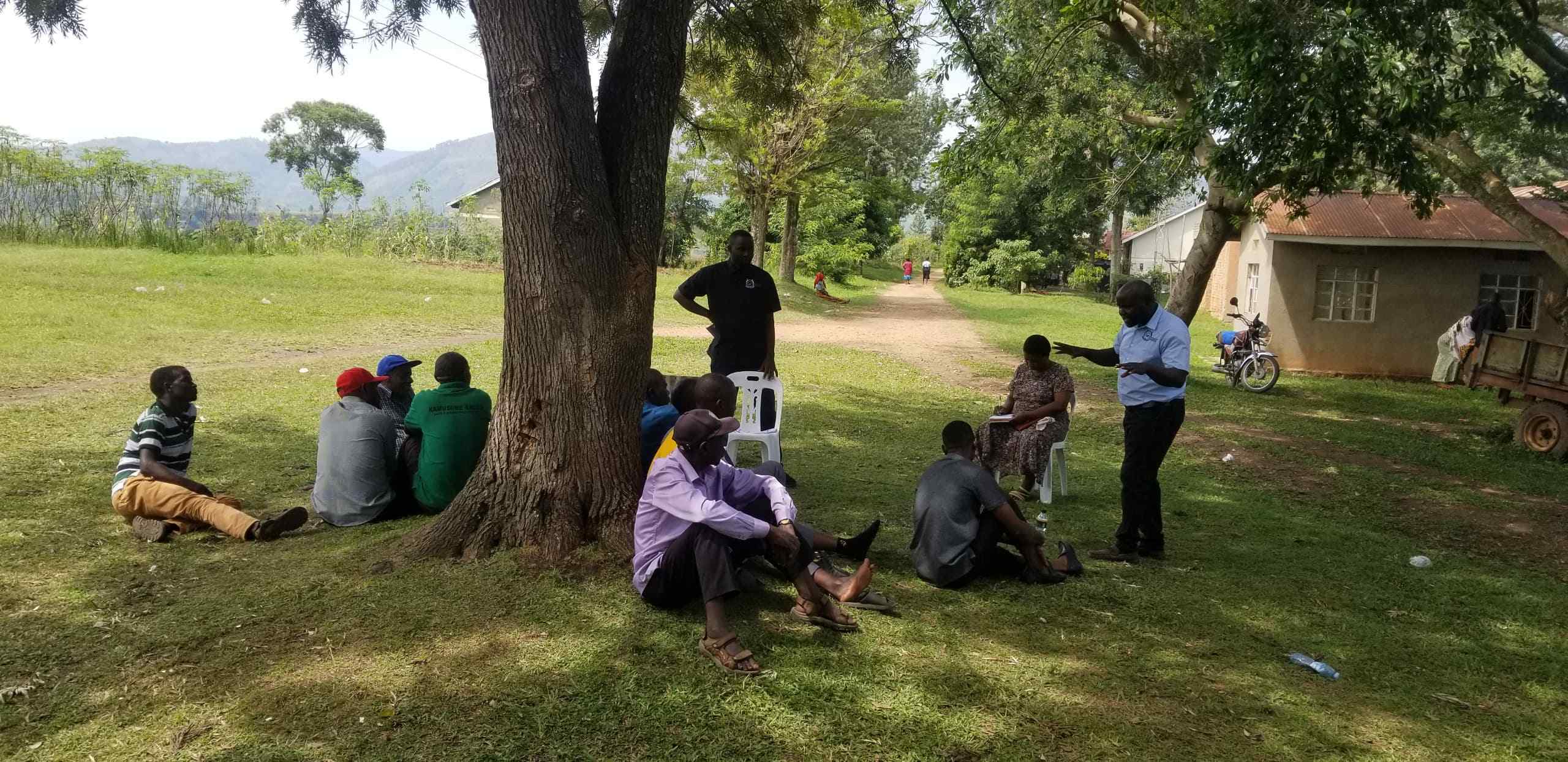
The FHRI evaluation, conducted on July 2, 2025, in Katerera, Rubirizi District, involved paralegals Osbert Ndyamuhaki and Amons Tumuheki, and internship student Musimienta Alex. The methodology included:
- Knowledge Assessment: Structured interviews and questionnaires to evaluate LC 1 Officials’ understanding of their roles under the LCCA, Cap. 18, and their familiarity with procedural laws and jurisdictional boundaries.
- ADR Evaluation: Focus group discussions to assess knowledge of mediation and negotiation, as encouraged by the Civil Procedure Rules, 2013.
- Court Effectiveness: Surveys to gauge community perceptions of LC1 Courts’ dispute resolution outcomes, focusing on case resolution rates and public trust.
The evaluation targeted LC 1 Officials in Katerera, ensuring findings reflect the challenges faced by village-level courts in Rubirizi District.
FINDINGS
The evaluation identified systemic barriers to LC1 Courts’ effectiveness:
- Knowledge Gaps in Legal Mandates: Many officials were unaware of their jurisdictional limits under Section 9 of the LCCA, Cap. 18, often attempting to handle criminal matters, as seen in Kizza v. Nansubuga. For example, an LC1 official in Katerera attempted to mediate a theft case, which should have been referred to the police.
- Limited ADR Expertise: Despite the LCCA’s emphasis on mediation, officials lacked training in structured ADR processes, leading to inconsistent outcomes. This mirrors findings in Namuganza v. Mukasa, where poor mediation practices led to an appeal.
- Operational Challenges: Inadequate record-keeping and lack of coordination with police undermined transparency and enforcement, as reported in a 2022 Daily Monitor article on LC Courts in Wakiso District.11 Only 45% of Katerera respondents rated LC1 Courts as effective, citing delays and perceived bias.
- Community Perceptions: While LC1 Courts were valued for accessibility, public trust was eroded by procedural errors and lack of accountability, consistent with a 2018 study by Okello & Tumwine and a 2021 HiiL report.
11 LC Courts Face Training, Enforcement Challenges.” Daily Monitor, September 15, 2022
These findings align with scholarly critiques. Mwesigye (2020)12 notes that LC Courts’ effectiveness is constrained by inadequate training, while Okello & Tumwine (2018) highlight jurisdictional confusion as a barrier to decentralized justice.13
PROPOSED INTERVENTION: LC1 TRAINING PROGRAM
To address these gaps, FHRI has scheduled a training program for LC 1 Officials on July 28–29, 2025, in Katerera, aligned with the Justice Law and Order Sector (JLOS) goals.14 The program’s objectives include:
- Clarifying Legal Mandates: Training on the LCCA, Cap. 18, and Judicature Act,15 to prevent jurisdictional overreach, as seen in Kizza v. Nansubuga(Supra). Officials will learn to handle civil disputes, such as a 2020 Katerera case where an LC1 Court successfully mediated a UGX 1,500,000 land dispute.
- Enhancing ADR Skills: Workshops on mediation and negotiation, drawing on the Civil Procedure Rules, 2013, and Zehr’s (2015) restorative justice framework, adapted to Uganda’s context.
- Improving Case Management: Training on record-keeping to address issues highlighted in Namuganza v. Mukasa, ensuring compliance with LCCA regulations.
- Strengthening Community Engagement: Strategies for outreach, inspired by Justice Centres Uganda’s successful mediation programs in Masaka, where LC Courts resolved 70% of domestic disputes in 2022.
The curriculum will cover:
- LC1 Court procedures under the LCCA Regulations, 2007.
- ADR mechanisms, referencing the African Union Mediation Handbook (201816).
- Community-based justice principles, drawing on JLOS’s 2019 training manual.17
- Practical case studies, such as a 2021 Jinja LC1 Court mediation of a debt dispute, documented by New Vision.
12 Mwesigye, A. (2020). Local Justice Systems in Uganda: Challenges and Opportunities. Kampala: Justice Press.
13 Okello, J., & Tumwine, P. (2018). “Decentralized Justice: The Role of LC Courts in Rural Uganda.” African Journal of Legal Studies, 11(3), 245–267
14 Justice Law and Order Sector. (2019). Training Manual for Local Council Courts. Ministry of Justice, Uganda.
15 Judicature Act, Cap 16
16 African Union. (2018). Mediation Handbook.
17 Justice Law and Order Sector. (2019). Training Manual for Local Council Courts. Ministry of Justice, Uganda.
DISCUSSION
The evaluation’s findings resonate with judicial and scholarly analyses. The High Court’s rulings in Kizza v. Nansubuga and Namuganza v. Mukasa underscore the need for training to prevent jurisdictional and procedural errors. Mwesigye (2020)18 argues that LC Courts are vital for rural justice but require capacity-building to align with legal standards. Okello & Tumwine (2018) highlight the tension between customary practices and formal requirements, a challenge evident in Katerera’s reliance on informal negotiations.
Media reports further contextualize these issues. A 2022 Daily Monitor article noted that LC1 Courts in Wakiso struggled with enforcement due to poor police coordination19, while a 2023 New Vision piece highlighted JLOS’s efforts to digitize LC Court records, a potential solution for Rubirizi.20 The HiiL (2021)21 report emphasizes that training in ADR can enhance LC Courts’ efficiency, as demonstrated by Justice Centres Uganda’s mediation programs in Lira.
CONCLUSION
The LC Pre-Training Evaluation in Rubirizi District reveals critical gaps in LC 1 Officials’ knowledge of procedural laws, ADR mechanisms, and case management, undermining LC1 Courts’ effectiveness. The proposed training on July 28–29, 2023, grounded in the LCCA, Cap. 18, and Judicature Act,22 and informed by cases like Kizza v. Nansubuga and Namuganza v. Mukasa, offers a pathway to address these challenges. By equipping officials with legal and ADR skills, FHRI aims to strengthen local justice systems, ensuring accessible and equitable dispute resolution.
Call to Action
Stakeholders, including the Ministry of Justice, JLOS, and civil society, are urged to support FHRI’s training initiative with resources and advocacy. Successful examples, such as Justice
18 Mwesigye, A. (2020). Local Justice Systems in Uganda: Challenges and Opportunities. Kampala: Justice Press.
19 LC Courts Face Training, Enforcement Challenges.” Daily Monitor, September 15, 2022
20 “JLOS Pushes Digital Tools for LC Courts.” New Vision, March 10, 2023
21 HiiL. (2021). Justice Needs in Uganda. The Hague Institute for Innovation of Law
22 The Judicature Act Cap 16
Centres Uganda’s mediation of land disputes in Masaka, demonstrate the transformative potential of well-trained LC1 Courts. By investing in Rubirizi’s LC1 Courts, we can build a model for community-based justice nationwide. Contact FHRI or attend the Katerera training sessions to contribute.
REFERENCES
- Kizza v. Nansubuga (HCT-00-CV-MC-0098-2008). Available at: www.ulii.org.
- Namuganza v. Mukasa (HCT-00-CV-MC-0134-2010). Available at: www.ulii.org.
- Constitution of the Republic of Uganda, 1995. Available at: www.ulii.org.
- Local Council Courts Act, Cap. 18. Available at: www.ulii.org.
- Local Council Courts Regulations, 2007 (S.I. 51-2007). Available at: www.ulii.org.
- Judicature Act, Cap 18. Available at: www.ulii.org.
- Civil Procedure Rules, Available at: www.ulii.org.
- African Union. (2018). Mediation Handbook. Available at: www.au.int.
- HiiL. (2021). Justice Needs in Uganda. The Hague Institute for Innovation of Law. Available at: www.hiil.org.
- Justice Law and Order Sector. (2019). Training Manual for Local Council Courts. Ministry of Justice, Uganda.
- Mwesigye, A. (2020). Local Justice Systems in Uganda: Challenges and Opportunities. Kampala: Justice Press.
- Okello, J., & Tumwine, P. (2018). “Decentralized Justice: The Role of LC Courts in Rural Uganda.” African Journal of Legal Studies, 11(3), 245–267. Available at: www.brill.com.
- Zehr, H. (2015). The Little Book of Restorative Justice. New York: Good Books. Available at: www.goodreads.com.
- “LC Courts Face Training, Enforcement Challenges.” Daily Monitor, September 15, 2022. Available at: www.monitor.co.ug.
- “JLOS Pushes Digital Tools for LC Courts.” New Vision, March 10, 2023. Available at: www.newvision.co.ug.
Prepared By: MUSIIMENTA ALEX
musiimentaalex2001@gmail.com Internship Student At: Foundation for human rights Initiative